



 74 / 100

An introduct ion for the general
T
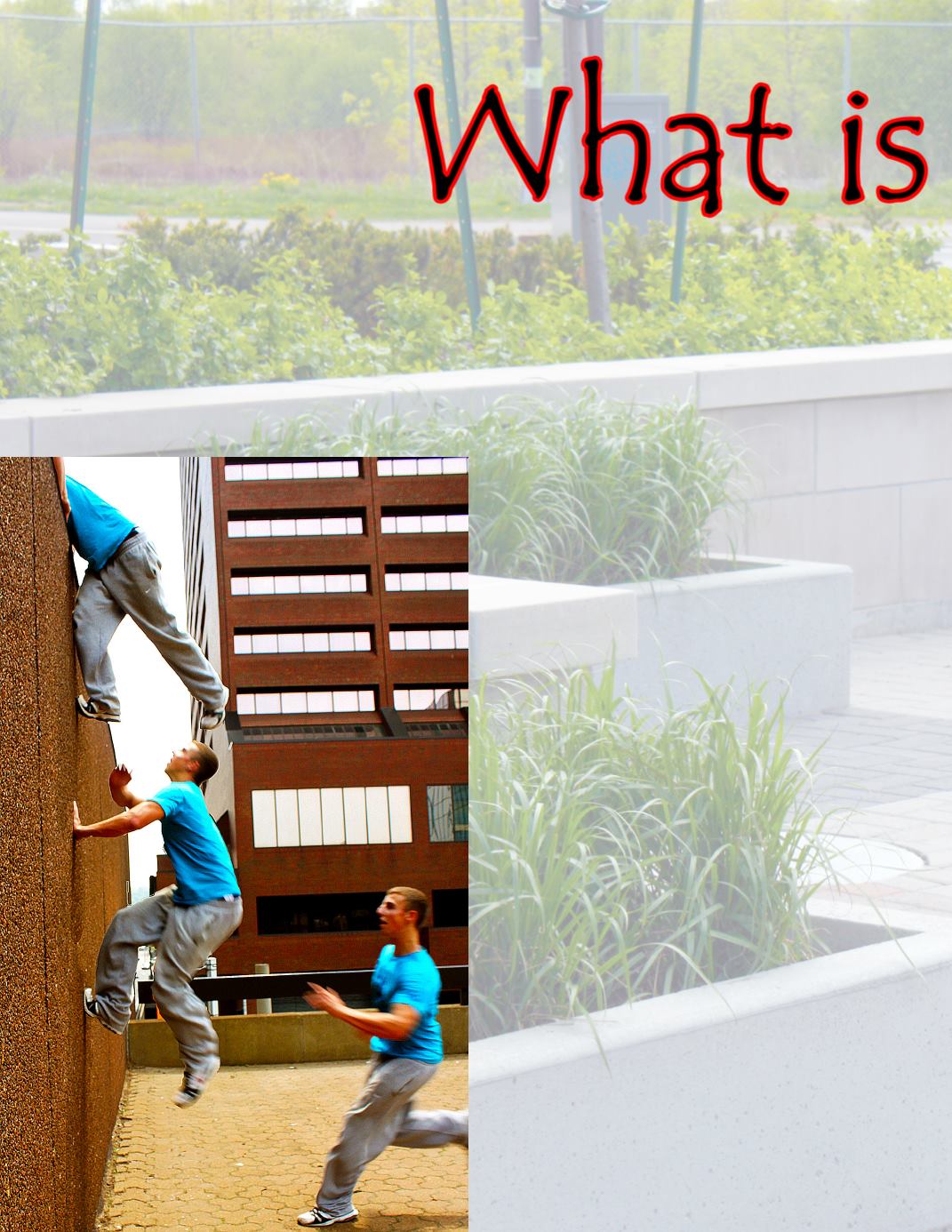
he essence of Parkour can be stated simply: it is
the art of overcoming obstacles as swiftly and efficiently as
possible using only your body. The fundamentals include
running, jumping, and climbing, and we build on these
fundamentals to improve our ability to pass over, under,
around and through obstacles with more complex move-
ments. Parkour is a system of fitness training that improves
strength, speed, agility, co-ordination, stamina, endurance,
and precision. It offers a full-body workout at any level of
experience, and improves your ability to move, to harness
your confidence, to change how you see the world. Parkour
practitioners are called traceurs.
History
Parkour as we know it today originated in France and was
popularized by a traceur named David Belle. Arguably
though, Parkour history goes back as far as that of human
beings. Sebastien Foucan, one of the elite French traceurs,
and recently featured in the movie Casino Royale, has
stated that when our ancestors chased game or were chased
by predators they were practicing Parkour. This emphasis
on the utility of Parkour is a common theme amongst the
French traceurs.
More recently Parkour can trace its roots to one George
Hebert. A French soldier and philosopher of physical cul-
ture, he was inspired by the athletic qualities of natives he
encountered while serving in the army in Africa. He devel-
oped a philosophy of physical culture from his observations
called Le Methode Naturelle (“Natural Method”). Meth-
ode Naturelle was based on the idea that humans had ten
essential movement capacities to walk, run, jump, climb,
move on all fours, swim, balance, lift, throw, and engage in
self-defense. One of the main methods Hebert proposed to
train these capacities was obstacle courses. These courses,
known as Parcours Du Combat, have become part of mili-
tary training systems throughout the world. Part of Hebert’s
philosophy was that physical training should strengthen
one’s moral fabric. His motto was “Être fort pour être
utile,” (“be strong to be useful”). As any traceur can tell
you, this is an important foundation of the Parkour philoso-